SPECIAL WARNING
General Weather Evolution for the Next Days over the Ocean and Europe
Europe: Analysis & Forecast maps
LIVE IMAGERY — CLOUDS • PRECIPITATION • TEMPERATURE • WIND
Synoptic development over the Atlantic and the European continent
Situation as of 8 October 2026
Behind the low-pressure system currently deepening over southern Sweden, with a central pressure of 997 hPa, significantly cooler maritime air has already spread into our regions.
New areas of rain currently reaching Ireland will continue to move eastwards and cross our regions on Friday. They are part of an extensive low-pressure zone with pressure values between 986 and 992 hPa, which at that time will stretch from Iceland to the northern North Sea.
On Sunday, this low-pressure circulation will gradually shift towards the Norwegian Sea and the Baltic, while pressure rises to 1001–1004 hPa. The maritime flow will continue to bring air with temperatures close to seasonal averages, although conditions will remain somewhat unstable, particularly across the northern Benelux.
Towards the end of the weekend, a high-pressure area, initially centred at 1018 hPa, will reach France and subsequently strengthen. Pressure is expected to rise to around 1024 hPa over Germany and, by Tuesday, to 1029 hPa over Poland.
This new anticyclonic surge will gradually stabilise the air mass over the Benelux while turning the flow towards southerly to southwesterly directions. Milder air will consequently be advected into our regions, although some cloud fields associated with weak residual disturbances may still pass through.
During the night from Wednesday into Thursday, a new frontal rain-bearing disturbance is then expected. This will mark the transition towards another influx of less mild maritime air, heralding a renewed fall in temperatures.
Probable weather evolution over Europe Likely trend (based on mid-tropospheric anomaly patterns)
https://www.bmcb.be/trend-europe-europa/
Synoptic trend from 14 to 19 October 2026
Data updated on 6 October 2026
Between 14 and 17 October, Belgium could experience the passage of a fairly active Atlantic disturbance, bringing relatively mild and humid oceanic air into our regions.
Behind this unsettled spell, a ridge of high pressure extending from the Atlantic could gradually build towards our part of Europe. It would be accompanied by the arrival of cooler air, although still quite normal for the time of year, while conditions become increasingly settled, with little or no rainfall expected.
The second half of the period could therefore evolve towards quieter, drier and cooler conditions, as Atlantic high pressure gradually strengthens its influence.
****************
National Thermal Indicator
MULTIMODEL BMCB
https://www.bmcb.be/national-t2m-indicator/
(These forecasts are generally updated daily)
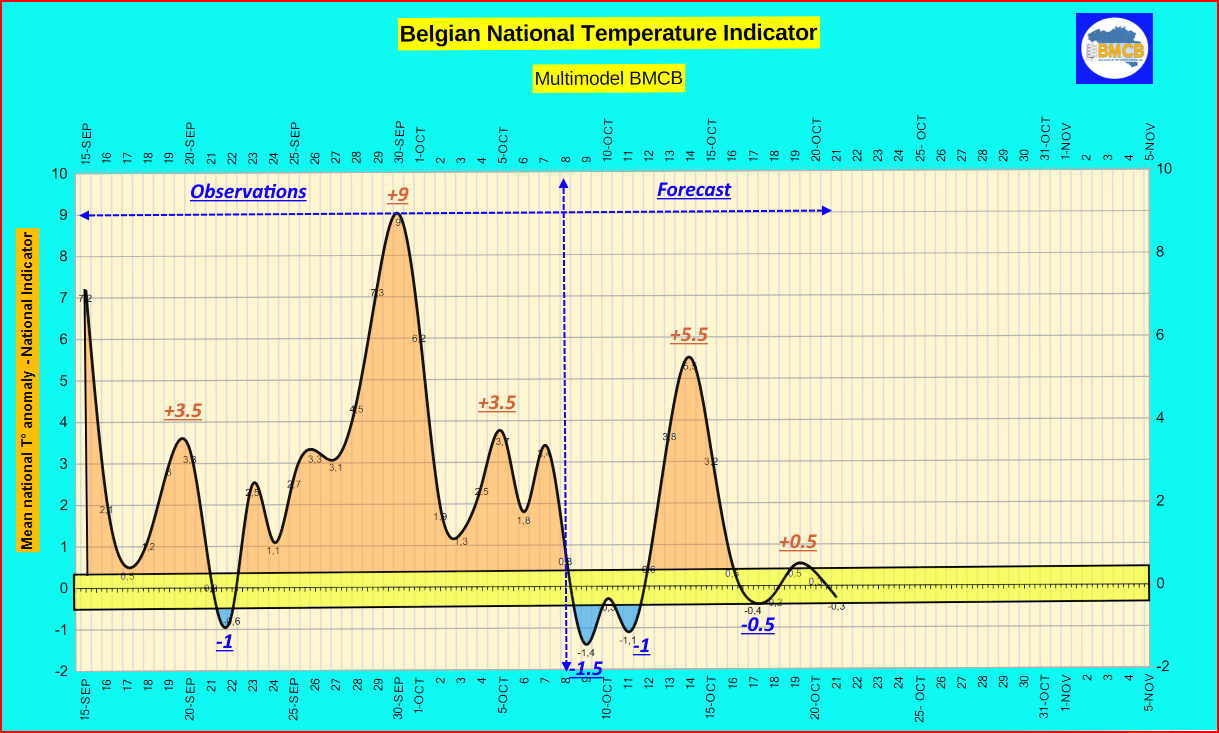
Temperature evolution
Belgian national thermal index
Update of 8 October 2026
Through the weekend, the Belgian national thermal index is expected to remain between −2 and 0, corresponding overall to temperatures close to seasonal norms, with daytime highs generally ranging between 11 and 17°C, depending on the region.
A marked rise in the index is then expected, reaching a peak between +5 and +6, ultimately higher than anticipated in recent days. This increase should bring a noticeable spell of milder weather: from Tuesday to Thursday, maximum temperatures could reach 15 to 22°C, depending on location.
Towards the end of next week, the thermal index is expected to fall again towards values close to neutral, corresponding to temperatures more in line with the seasonal average. Daytime highs would then return to around 11 to 17°C, locally even 18°C.
*****************
Forecast for the coming days
Multimodel BMCB ( OPERATIONAL + ENSEMBLES ICON-GFS-ECMWF-AIFS-GCGFS )
Forecast of the range of temperatures, precipitations + general type of weather in Belgium
(These forecasts are usually updated daily)
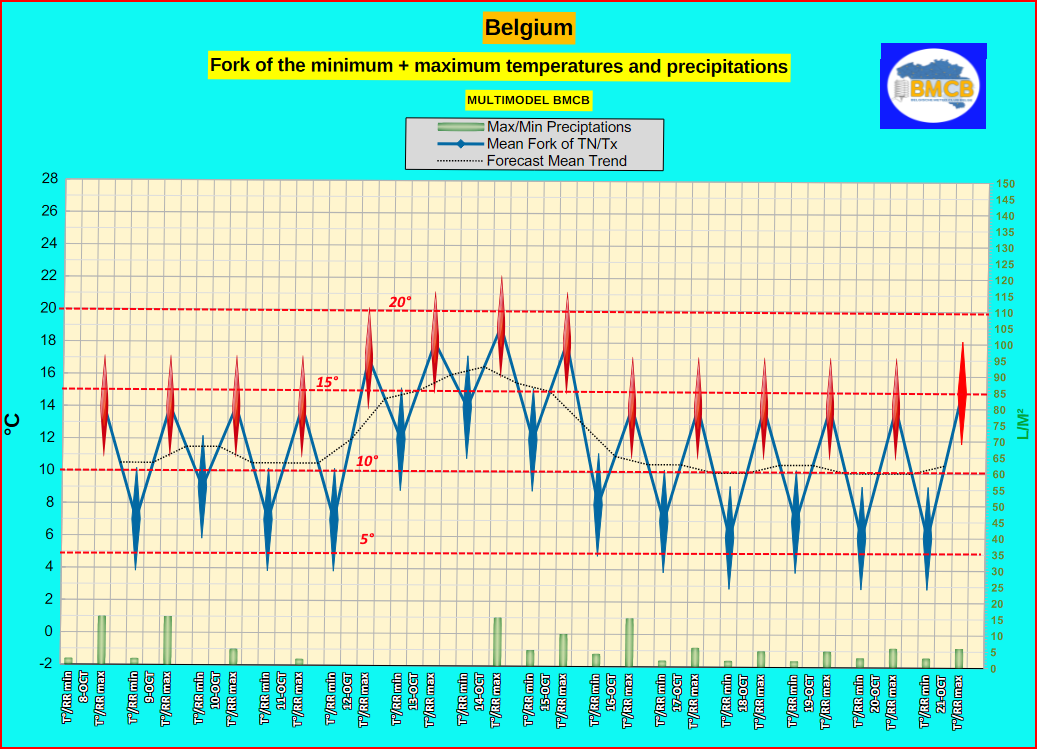
Weather outlook for Belgium
Update of 8 October 2026
After several cool and windy days with occasional showers, conditions should gradually become more settled at the beginning of next week. On Monday, 12 October, sunny spells will become more widespread and temperatures will begin to rise again. Tuesday should remain mild, although cloud will gradually increase.
From Wednesday, 14 October, a new Atlantic disturbance will move in from the west, bringing rain and showers accompanied by fairly strong winds. Temperatures will nevertheless remain very mild for the time of year.
A gradual cooling is then expected between 16 and 18 October, with cooler conditions and occasional light showers. At the beginning of the following week, temperatures may rise slightly again, while the weather remains changeable with occasional light rain.
Overall, the period should therefore be characterised by a succession of unsettled spells, temporary improvements and fluctuating temperatures, with no genuine outbreak of winter weather currently in sight.

SOURCE: METEOCONSULT
BENELUX:
Weather Outlook for 3-4 weeks
Update 2-10-26
3–4 Week Outlook
Week of 19 to 25 October: a return to drier weather?
Generally settled and drier conditions could gradually become established during this period. High pressure positioned over the Atlantic and the British Isles should act as a barrier to Atlantic disturbances, helping to shield our regions from a succession of wet weather systems.
Week of 26 October to 1 November: continued dry and seasonable conditions
This trend could continue during the final week of October, with the area of high pressure potentially extending further towards northern Europe. Its influence would favour continued dry conditions, although temperatures would gradually become cooler as the prevailing flow turns northeasterly.
Across the country as a whole, temperatures should generally remain close to seasonal averages, with no major thermal anomaly expected.
***************
Weather Outlook for 3 months
El Niño: what effects will it have on Europe?
Update of September 14, 2026
El Niño is expected to continue influencing the global climate background through autumn and into the beginning of winter. Its impact on Europe, however, remains largely indirect and highly variable. El Niño alone therefore cannot determine what kind of weather we will experience across our regions.
The key factor will be the evolution of the atmospheric circulation over the North Atlantic, together with the position and development of the main pressure systems — anticyclones and depressions — that govern Europe’s weather.
October — persistently mild and relatively dry
Mild conditions should remain dominant, with temperatures potentially around 1 °C above the seasonal average.
The return of more frequent Atlantic disturbances could still be delayed. Anticyclonic conditions may therefore remain important, favouring settled, often dry and at times very mild weather.
October could consequently remain drier than normal, prolonging the effects of the rainfall deficit inherited from the summer.
November — more Atlantic disturbances, but still mild
A change in the weather pattern could then develop, with a more clearly oceanic circulation becoming established. Atlantic disturbances would become more frequent, bringing rainfall totals back towards normal, or perhaps slightly above normal levels.
Such a development would be favourable for the gradual recharge of soil moisture and water reserves.
The mild conditions would nevertheless persist, with temperatures potentially remaining around 1 °C above normal.
December — a very mild and wet start to winter
At this stage, there is no convincing signal pointing towards a cold start to winter. On the contrary, the trend suggests continued mild conditions, with temperatures remaining around 1 °C above seasonal normals.
Brief cold outbreaks would of course remain possible, but they could be short-lived and insufficient to produce a lasting change in the overall weather regime.
Rainfall is expected to be near normal to slightly above normal, within a circulation pattern that could remain relatively oceanic.
In summary
At the present range of the forecast, the most likely scenario for our regions would therefore be a generally mild autumn: still rather dry in October, increasingly unsettled and wetter in November, followed by a mild and relatively wet start to winter in December.
Nevertheless, caution remains essential at this timescale. In Europe, the influence of El Niño is never mechanical. A change in atmospheric circulation over the North Atlantic can radically alter the character of the season within only a few weeks.
**************
from ICON (replace location left above )
from ECMWF (replace location left above)